|
The first thing you need to know about Dario Argento’s films is that when watching them, you need to throw logic out the door. His films are about visual beauty, unique and terrifying images, and the fright-inducing journey into the ephemeral unknown, where logic no longer applies. The second is that you need to expect a visceral, brutal, bloody, and often sexy ride. This is represented best in Suspiria, which many consider to be his masterpiece.
The story is that of a young ballet student, Jessica (Suzy Bannion), who comes to Germany to join a prestigious all-girl dance academy. On her journey to the school, her cab passes another young girl, running through the rain, terrified, away from the campus. That girl, who is found murdered a day later, will be revealed as a fellow student in Jessica’s school. The murder instigates the nosy nature of our young heroin; mystery is afoot.
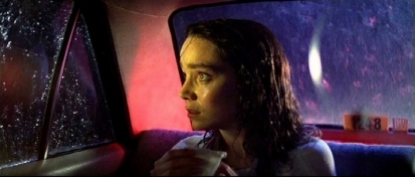
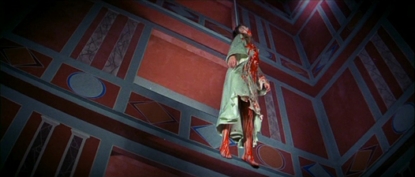
Now, I should clarify that when I say the girl is murdered, I mean she is effin’ goddamn MURDERED. In a scene still legendary amongst many film buffs, our young victim has her face mashed through a window, is choked, stabbed, has her rib cage cracked open, is stabbed directly into her still-beating heart, and is finally dropped through a ceiling-panel window and hung from the rafters of the 50 foot high apartment lobby. It’s the most thorough murder this side of Rasputin.
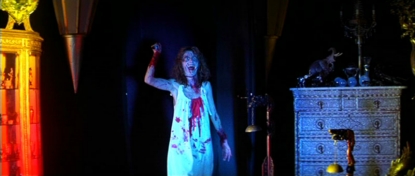
What follows is a journey into mystery, as our headstrong protagonist follows the trail of the dead girl, and deciphers the strange, authoritarian behaviors of the school’s headmasters. What she discovers is a coven worshipping a powerful witch, Mother Suspiriorum, hidden in a labyrinth that runs under and through the school. One by one, the girl’s friends and allies are brutally tortured and murdered, and as her time runs out, her only hope lie in unraveling the mystery of Suspiriorum’s hiding place, and a battle to the death with the ancient witch.
As I said, this isn’t a logical story. Why does the witch even have this school for girls?** Its suggested that she and her two sisters (more on them later) control the world with their ancient evil, so I can’t imagine they need the money. Is she using the girls’ school to find apprentices? Does she use their youthful energy to maintain life eternal? Hell, she could eat them for all we know. But either way everyone who discovers her existence becomes a target for the witch, and that spells evil in my book.
The story is a loose framework for a series of memorable, horrific images. For instance, a girl trying to escape the school crawls through a vent, and falls into a room full of razor wire, tangling herself therein, and painfully struggling across the room, only to have her throat slashed at the door. Why is this room of razor wire in a dance school? Who is holding the knife? We have no idea, but damn, it’s a hideously cool scene.
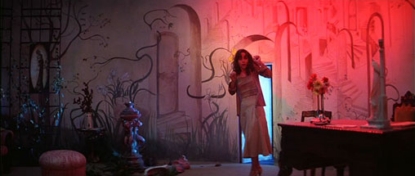
Ultimately, that’s what Suspiria is, a chain of amazing horror vignettes. It’s a movie that’s not like so many other horror films, just a series of cheap jump scares; it works hard to create a sense of mystery, paranoia, and danger, and that sensation lingers with the audience long after the film is over. Argento and cinematographer Luciano Tovoli pick the most amazing locations, and shoot them in a gorgeous, surreal red and blue palette that makes even the most ordinary scene seem supernatural. The score from fan favorite band Goblin adds a unique blend of rock, funk, and suspense that no one can duplicate.
The quality of Argento’s cinematic craftsmanship makes this a worthwhile horror film on a multitude of levels. The story behind the horror isn’t the strongest, but it does gain support in the battles against Suspiriorum’s sisters, and that brings us to…
** After completing this article, a little research uncovered the fact that Daria Nicolodi, a frequent actress in Dario’s work, as well as his baby-mama, once attended a music school in Germany that was supposedly a front for a group that studied black magic. It still doesn’t explain why in story Suspiriorum would need to run such a school, but at least we know that it has some basis in the creators’ life experience.
|
|
Inferno is, in many varied ways, both superior and inferior to its predecessor Suspiria. The film contains many of the same elements, and has the same technical characteristics, used in the manner only Argento can. But it is a film of the 80’s, and has the taint of that decade and its excesses upon it, which may or may not fit with everyone’s tastes. The techniques in lighting and set design that provided so much spooky atmosphere in Suspiria look unusually artificial in Inferno, almost putting a candy-coating over what should be a very dismal setting. The vignette styling is still there, but is even more arbitrary, pushing the film a little too far into the realm of coincidence.
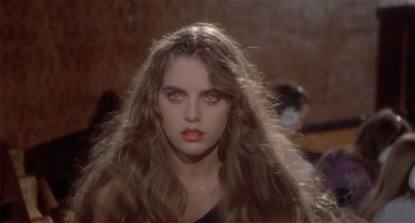
But while Inferno is not as tight of a production as Suspiria, it more than makes up for that flaw with deeper sense of mystery, and an abundance of shock value. Most importantly, the mythology of the series is explored as is the powers and purpose of the Three Mothers. Er…mostly. The ambiguity of the Mothers’ almost incomprehensible M.O. continues to defy logic; but we can just say that mere mortals aren’t supposed to understand such things, and let it slide, enjoying the terrific ride once again.
This time, the story focuses on the battle against Mother Tenebrarum, the Mother of Shadows. The cast is less focused in this outing, never giving the audience any time to really get to know or appreciate any of the many investigators trying to figure out just what the hell is going on around them. In fact, the only ‘main character’ to speak of is the totally uncharismatic Leigh (Mark Elliot) who bumbles his way accidentally through to the film’s climax. While the characters are weaker, the time saved from their lack of development does allow for a bigger, globe trotting adventure that moves back and forth between New York and Rome. It can be said that Rome isn’t utilized enough; its aged and magnificent buildings make for incredible scenery of gothic brilliance that is only briefly seen in the film. When it does make an appearance though, such as in the library sequence, the effect is magnificent.
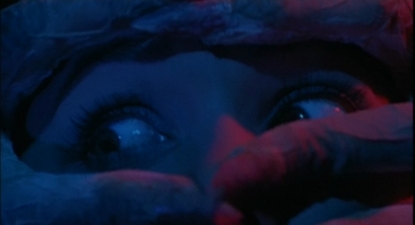
The film treats us to a few details about the legacy of the Three Mothers read from a book written by an alchemist who was once in their service. This rare tome’s existence is unknown to the witches (despite there being three copies in the bookstore on the same block as the coven). The book is discovered by a young lady who lives above the New York coven; her subsequent investigation tips off sister Tenebrarum to the book’s existence, and soon the witch begins sending out her shadowy, magic assailant to kill off those who might learn her secrets from its reading. And their families. And maybe a few unrelated servants in their houses as well. She’s a bitch like that.
As the menagerie get closer to her hiding place (her coven is under an apartment complex. Again, why? Does she need to collect the rent money? If she’s so damn secretive, why let anyone in the building at all?) the body count rises quickly. These sequences, where the shadows stalk their prey, are all extremely imaginative, incredibly intense, and wickedly fun. Again, forget the whys and hows of the story, and just allow yourself to be amazed. You’ll be stunned by the betrayals and the cruel twists of fate that Tenebrarum has in store for her victims this time around. The Three Mothers are a primordial force, Death, and Inferno displays proudly how they earned that name.
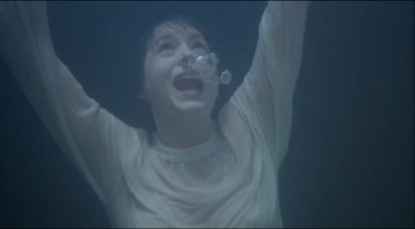
Argento calls this ‘one of his most sincere films’ and it shows in the work. The narrative framework is still pretty rickety (and in a couple instances, downright contrived), but the scares and the carnage have seldom been better, the mystery is thick and laired, and you can tell that this film had an unprecedented amount of effort put into both entertaining and frightening its audience.
And if that weren’t enough, Goblin is back with another amazing, rocking set of terror tracks. You can’t go wrong.
The battle in New York against the third and final of the Three Mothers can be seen this year, after a 28-year wait. Mother of Tears will be released on DVD September 25th.
|


 review by: