|
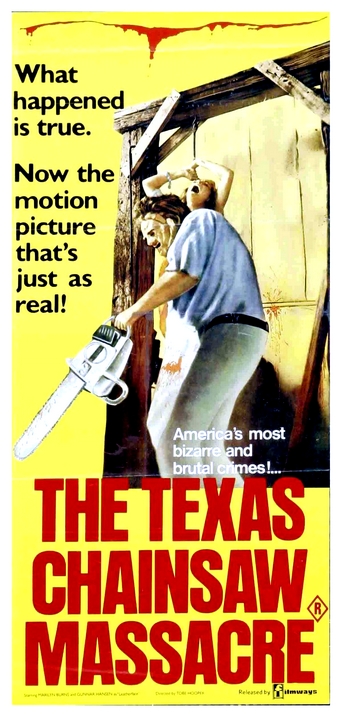
The Texas Chainsaw Massacre (1974)
Starring Gunnar Hansen, Marilyn Burns & Edwin Neal
Directed by Tobe Hooper
Written by Kim Henkel & Tobe Hooper
|
|
 "Because I couldn't find the food that I liked. If I had found it, believe me, I should have made no fuss and stuffed myself like you or anyone else."
- The Hunger Artist, Franz Kafka
"Texas is an outrage . . ."
- Bullet, The Misfits
It starts with a rumble. The sound of something lurking beneath the surface. Then there's the whine. A shrill timbre that escalates to the point where the viewer isn't certain if the ringing has stopped, or if their own ears have kept the sound resonating. These two tones have set the watermark for American Horror. They've been used whenever the ominous needs to be presented. (Even in such highly acclaimed fare as Silence of the Lambs, or more recently in There Will Be Blood.) And they're established within the first ten seconds of this picture. To say that Texas Chainsaw Massacre has impact is an understatement. It would be more accurate to say that Texas Chainsaw Massacre is reincarnated in any movie that wants the audience to squirm.
The premise is nothing new. Dead bodies. Kids. Desolation. Hitchhiker. Stranded. Creepy house. Butchering. Cannibalism. Resolve. It's not the steps that matter, it's the dance. (Rudyard Kipling argued that there were only 69 conceivable plot lines. His estimate is far more generous than most. King Kong scribe Edgar Wallace went so far as to patent and market a Plot Wheel. Equipped with a spinner, the blocked writer could spin the dial to conjure up some action to further propagate the story.) There isn't a single subject here that hasn't been tackled previously. Familial cannibalism was addressed a few years prior to Texas' release in Jack Hill's Spider Baby. The premise of strangers stranded in a strange land is rooted to the early days of cinema in such works as The Lost World, or The Most Dangerous Game. What Texas Chainsaw Massacre offers is grit. The Texas landscape and all it's dilapidated structures, as presented in the movie, are as harsh, unyielding and merciless as the antagonists. Every frame is uncomfortable. In this place, the feeling of menace is palpable.
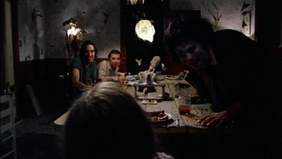
 If Franz Kafka had written slasher movies, Texas Chainsaw Massacre would have been the result. As opposed to conventional fright, which is played against legend and the supernatural, the "monsters" in TCM are the products of creative destruction. This Texas family has ingrained itself in the local industry for generations. In a fit of poetic irony, their survival is dependent on the killing of cattle. This is soon compromised. The mechanization of the kill floor has rendered the family obsolete. The retractable bolt gun has replaced the sledgehammer, and with it this family. In the modern society, our work becomes us. We adopt and carry our jobs out of the factories and offices into our own lives. Gregor Samas awoke to find himself an insect. His immediate concern was how he would be able to manage his job. In Los Angeles, transit employee Arthur Winston missed only one day of work in 72 years (which was to attend his wife's funeral), he died within a month of retirement. I work in a government office inundated with elderly employees who are nothing more than furnishings. One such man, who is ten years past retirement, put it succinctly, "If I stop working, I die." In the case of Massacre's Sawyer family, they had to survive by means of their sole occupation - the slaughter. Like Dawn of the Dead, TCM is one of the most biting social commentaries that was truly ahead of it's time. Horror has devolved from commentary into practice for teens with DV cameras, or quick theatrical releases meant to cover their costs and provide a small gross over a few weekends before disappearing into the Blockbuster Exclusive DVD oblivion.
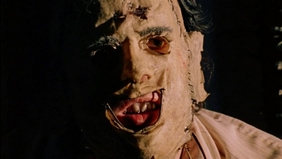
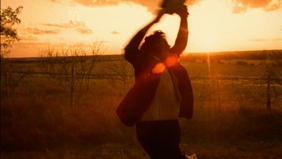
 This isn't a review. This is a man doting over a movie he loves. Any fifteen-year old can sit and think up unusual manners to kill off a character. But to make an act of violence meaningful - to give it weight - that's the challenge. It's this element that's disappeared from contemporary horror. The heart has been replaced with sheen. Nothing is ugly anymore. In Leatherface's swan song, he hoists his chainsaw overhead and spins like a child. It's the grotesque final number to this morose ballet.
It happens in music. A band collectively creates something that transcends their own talents and touches a wavelength they've never known before. (For a display of this in a movie, see the creation of Whoop That Trick in Hustle & Flow.) Sadly, the moment is fleeting and soon the pressure to capture whatever they once had becomes impossible. The parties involved with Texas Chainsaw Massacre would never know such success again. Though the screen credits Tobe Hooper as the director of Poltergeist, it's widely known that the production was Speilberg's show. (For more info on this, click this link.) Hooper was never able to successfully transition into mainstream Hollywood and his career has since stagnated in the fringes. The only person of note involved with Massacre, deservedly, would be Director of Photography Daniel Pearl. His most recent work was AVP2: Requiem, easily one of the darkest movies I've ever seen. (I don't mean tone, I mean literally. I couldn't make out a damn thing, it was so poorly lit.) I would argue that Massacre shows the height of his abilities. Following the chase through the thicket, the staging of the headlights as the sole light source in the open Texas night rivals the finale of Hud in mood and composition.
The rest of the cast, like the Sawyer family, can be found in the outskirts. They've become novelty bookings on the Horror Convention Circuit. They're given bit parts in Z-grade productions and interviewed on sites not unlike this one. It's a nod to that Texas summer - to a time that's looked back upon with romance.
Though their cage is now off in the corner, people still wander over to see them. To remember a time when things seemed, simple.
|
 review by: