|
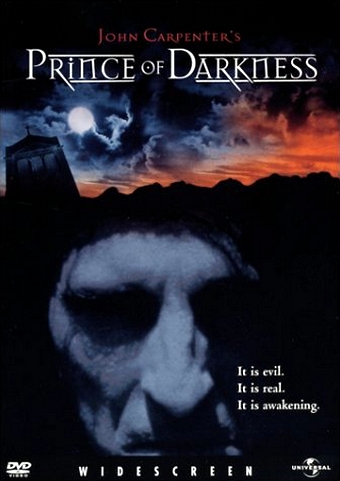
Prince of Darkness (1987)
Starring Donald Pleasence, Jameson Parker & Victor Wong
Directed by John Carpenter
Written by John Carpenter
|

Classic John Carpenter is some amazingly cool and campy stuff. Always strange and inventive, his best works were totally unpredictable, and often terrifying. The director has a few new items in production that could rekindle the magic, but it’s been over a decade since the director delivered ‘the goods’. Last issue, Angel referred to They Live as the one that marked the end for Carpenter’s legendary run of camp films.
Not so, I say. While They Live certainly was a hit and miss (mostly miss) film, there are still a few gems that followed it in release that were more than just footnotes, they were fantastic exercises in horror, and need to have proper credit given to them. They are the back two entries in what Carpenter refers to as his ‘apocalypse trilogy’, which begins with the universally revered The Thing, and continues in Prince of Darkness and then In the Mouth of Madness.
Three seemingly unconnected films all linked by one common theme: the end of the world, in various stages of completion. All three are fantastic, and today I’m here to defend the merits of Prince of Darkness.
An interesting trivia bit about this movie too; Carpenter was trying to get budgets for They Live and Prince of Darkness gathered at about the same time, but the studio said they had too much on their slate, and he had to choose between the two films. Unable to choose between two children, Carpenter decided to film both of them with the budget he’d gathered for They Live, working on a budget, and doing more of the principle work himself. You’ll have to excuse some iffy effects, but the story was just begging to be told.
 As Prince of Darkness begins, an old priest dies, and sends for his protégé Father Loomis (Donald Pleasence, with a nod to his detective from Halloween) to continue in his work. What these priests do is protect an old church in Los Angeles, which contains in its bowels a terrible secret, a terrible… life.
Loomis is unprepared to keep this secret himself, so he invites his friend Professor Howard Birack (Victor Wong of Big Trouble in Little China) and his class of experimental physics students, as well as a few students of the electronic engineering and linguistics departments, to experiment on the books and chambers under the church that he might better understand what this threat is. With luck, science might be able to find out what the priests have been hiding, and find a better way to contain or destroy it.
Luck is not with this crew though. The linguists translate a document that outdates the bible, which says that the Bible, as we know it, is a lie. God is not the all-powerful being we thought him to be, though he is the representative of all matter and life. Christ, his emissary, was extraterrestrial in origin, and came to warn man of impending doom before we killed him. His warnings unheeded, Satan himself came upon the Earth, acting as Christ’s equal opposite, preparing to usher in this doom. He seeks to pull God’s antithesis through the mirror, where he lives in a dimension of chaos. If Anti-God enters our world, his anti-matter existence will destroy all life as we know it.
 If true, this is a horrible realization. If nothing else, they’ve made an incredible historical discovery. But even as the linguists finish their work, the physics crew discovers the chamber that contains the viscous, oozing remains of Satan. It seems he’s been locked in a cylinder for centuries; but the cylinder is locked from the inside! He’s been waiting for something…waiting for them…their experiments have inadvertently set Satan free upon the Earth.
Right off, the synopsis of the movie is pretty cool. It’s a little far out there, if you’re not into Vatican conspiracies, but you don’t get much grander of a challenge for your cast to solve than ‘prevent the apocalypse’, and the notion of an anti-God, an ultimate destroyer as powerful as the creator, is fascinating.
Its depth like that which makes this Carpenter’s most thought provoking film. He takes an interesting abstract theory and applies to it quantum physics and the nature of sub-atomic particles to make a movie that poses some interesting questions about the nature of reality and religion, as well as give something as simple as a mirror a new sinister purpose.
 There’s still plenty of Carpenter’s trademark camp. Dennis Dun (also of Big Trouble in Little China) joins the cast as wisecracking Walter, and while his antics make him almost endearing at first, some of his jokes are a little forced, or downright nonsensical. The fact that he keeps making them while being chased by the animated corpses of his fellow team members really makes him cartoonish, and kills a number of the scenes he’s in.
Also veering dangerously close to the edge of campiness is the inclusion of Alice Cooper in the cast. The use of homeless as the antagonizing force of Satan works pretty well. Vermin and insects are drawn to his evil powers, as their wills are weak, so all of the homeless insane released into the streets by President Reagan’s 80’s shutdown of all the mental clinics also succumb to his call. It’s a little bit of unspoken political commentary, and a nice addition to the growing threat… but Alice Cooper just pulls me out of the movie every time I see him. Not that I lament his inclusion, I love the man, and he makes a great stab-happy homeless guy, but the movie is just that much less serious for his presence.
…Ignore the look of the green Satany-spit. Like I said, they split the budget.
 But what makes the film really work is that despite the few laughable moments in it, its still terrifying. Perhaps more so than Carpenter even intended it to be.
The element that makes this work is the recurring dream that the physics team has while in the church (another interesting fact: the church is the same one where Cary-Hiroyuki Tagawa dumps headless dead hookers in Showdown in Little Tokyo). The dreams all hold the same pattern: A shaky news cam shot from outside of the church, the doors have busted open and fog rolls ominously down the stone steps. A figure stands in deep shadows in the doorframe, as a deep, distorted voice warns them. “This is not a dream. We do not have the ability to contact you directly. We are broadcasting these images to you using your unconscious brainwaves. We are contacting you from the year 1999…” But before the figure’s face is revealed, they awake.
These visions are being sent to them from a source in the future that knows who they are and why they are there, warning them that they are about to set loose the Apocalypse, which will come at the end of the century. The dreams themselves are unsettling enough, but the final revelation as to the identity of the shadowed figure completes the cycle of the film and leaves the audience chilled. Don’t expect a happy ending, you’re going to leave disturbed.
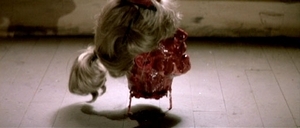
So, despite the low budget, and despite a few moments of goofiness, Prince of Darkness delivers some really effective scares, and uses incredibly interesting concepts, constantly assaulting the audience, warping their minds. Beautiful.
Only one of Carpenter’s works since can really top Prince of Darkness, and next issue we’ll discuss it, In the Mouth of Madness…
|
 by:
by: