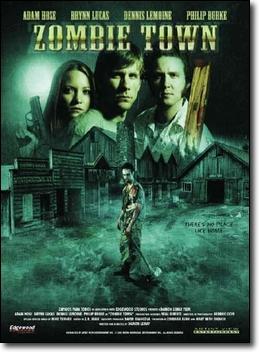
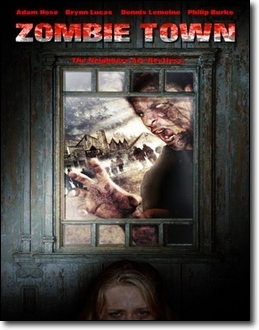
 What happens when zombies take over your small town, population under 200? Well on the plus side you get to shoot your annoying bosses, lousy neighbors and obnoxious third grade teachers in the face but on the down side you also have to shoot your less-annoying co-workers, friendly neighbors and your grandma in the face too. It’s this concept of having to fend off the familiar that is rarely touched on in full-on apocalyptic zombie flicks (Dawn Of The Dead, 28 Days Later, Shaun Of The Dead) and in even in most ‘localized outbreak’ flicks (The Mad, Dead and Breakfast, Night Of The Living Dead) the action centers on a hapless victim who is usually passing through or just visiting an area which in turn falls victim to zombie hell. True, most tend to deal with a moment or two when the hero(s) need to deal with the sudden turning of one of their companions but few, if any, center on the reality that if zombies took over you’d have to face a lot of your former friends and family if you were to survive.
That’s where Zombie Town fits in! Yes, it’s a zombie film and perhaps you’re not expected to get very much new or inspiring from it, director Damon LeMay even said “…to take off the thinking hat, crack a beer and have a good time.” In describing his film, but that doesn’t mean they shouldn’t add a little something to the genre. After all, I’m sure any “Zombie fan” knows that there are countless zombie films constantly being churned out left and right and if you plan to make one and have it stand out in any way you have to make the audience see the zombie outbreak in a slightly new light.
I have seen my fair share of zombie films, big budget and small, and am proud to say I enjoyed almost every single one in some way or another so far (Except for the “Day Of The Dead” remake… my God!) but most of them do tend to just go over the same plot over and over again without adding much of anything. What the (undead) world needs more of is films like Zombie Town which add a little something, have characters that are believable and ‘normal’ that we can associate with and, most importantly of all, have plenty of good old-fashioned splat gore!
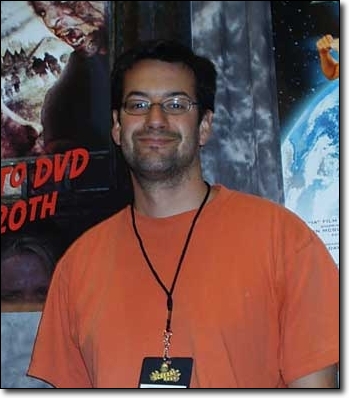
Anyway, enough of this gay banter and on to the point! I recently had the good fortune to be able to ask writer/director Damon LeMay a few questions about “Zombie Town” and here they are in all their glory:
Spike Vicious: What made you decide to make a zombie film in your debut as writer/director?
Damon LeMay: First I should just say that I love Zombie movies. I think it’s a great genre, which offers a lot of different avenues for a director to explore. Having said that there were a few practical things that made the genre attractive for a small debut feature. First, it’s affordable. Zombies don’t require a lot of CGI. They don’t require a lot of model work. It’s really all latex and carro syrup, so your main cost in the effect department is just the skilled labor needed to execute it all. Second, the genre offers a lot of opportunities for humor and I wanted to work with some broader strokes my first time out.
SV: "Zombie Town" has a unique story behind the "infection" - regarding bizarre slugs spreading a virus to the brain causing "rabies-like" symptoms in the host. A lot of zombie movies aren't nearly as specific about the origins of the infection, is there a reason you felt an explanation was more necessary? Did you feel compelled to make the explanation unique or was it just natural for you to come up with an original background?
DL: In answering this, I have to start by saying that there are two primary reasons to make a zombie movie. The first is to exploit the main dramatic element of the zombie film which is that you’re essentially applying a massive faceless pressure (the zombies) to a group of people (the survivors) to see how they react to it. Do they live or do they die? Do they work together and improve their chances or do they fight and destroy themselves from the inside? The zombies really operate as just a blank symbol of death with which there can be no negotiation and no surrender. In these films the origin of the zombies is really unimportant and in fact can even be a distraction. The movie’s not about the zombies, it’s about the people.
The other reason to make a zombie movie is simpler: to watch things splatter. Nothing offers such guilt-free opportunities for carnage as a zombie. It has no thought, no hopes, no dreams, no capacity for love. It doesn’t even have the capacity to feel pain. This allows one to do the most hideous things to them with gleeful enjoyment because, hey, they’re dead already! For the less serious zombie film [your Dead-Alive, your Shaun of the Dead, your Evil Dead] this protects you from the darker elements found in slasher films and other high-bodycount genres. It allows for gleeful, if blood-soaked, anarchy.
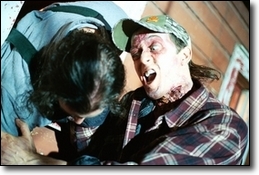 Zombie Town is definitely of this second category and I felt that the audience for these films enjoy some explanation for how they got there. These films are about going for a ride and the answer to “how did it happen” is part of the ride. In the serious zombie movie this answer risks seeming silly and taking away from the mute press of the zombie hordes. In the splatter zombie film the answer may also be silly, but that’s all part of the fun.
SV: It seemed like there were very few, if any, CGI effects used in the film, particularly in with respect to the blood and gore, which are all incredibly well done. Was this a conscious decision that you made in order to maintain a realism that a lot of horror fans enjoy, or was it merely a budget restraint that might have been different if you had had more money to use on effects?
DL: There are no CGI shots in Zombie Town. The slugs in the sheriff’s office are puppets in front of a blue screen, which we comped in later. Outside of that, everything was done on set.
The decision to use all practical effects was a combination of aesthetic and budget reality. It should be said that this film was made on a very, very modest budget. That being the case, passable CGI would have been a big stretch for us financially. Having said that, I personally am not a big fan of CGI. My feeling is that regardless of a movie’s budget the goal should be to do everything on set with CGI being the backup plan you only move to reluctantly. Practical effects always look more real and, in my opinion, the challenge of making them work can often lead to a more creative staging of the scene.
SV: How important do you think gore is in horror films? How important was it/is it to Zombie Town?
DL: The honest answer is that it varies. There are horror films that require very little. As an example, I was always impressed with how little gore there was in The Ring. For other films, including Zombie Town, it is very, very important. We weren’t offering a creepy drama here. Zombie Town is not about a tightly constructed narrative. It’s not about exploring the extreme edges of the human experience. It’s about chaos and splatter. We’re asking the audience to take off the thinking hat, crack a beer and have a good time. In exchange they’re looking for humor and gore, so for us that element was absolutely essential.
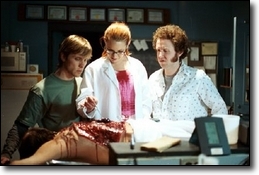
SV: What does litigious mean?
DL: Prone to legal action.
SV: Randy, the more blunt and straightforward character in the film, makes a comment about the infection being part of some political espionage - a theme prevalent in some other Romero-esque zombie films, and is the first to suggest going round town and "just shooting them in the fucking head!". Was this a little jab at other zombie films, just an homage, or am I reading too much into what was actually just some kick-ass lines?
DL: While I’ll readily admit that Romero’s films are among my favorites, there isn’t any direct homage to him in Zombie Town. Randy’s theory about bio-warfare is supposed to be a humorous bit of character development. It’s the sort of paranoid, half-baked theory that only a slightly hyperactive redneck like him could come up with when faced with zombie-making slugs.
SV: There are several scenes in Zombie Town that mix quite grizzly subjects with humor, for example when the "Bad-ass Biddies" make their way to their children's homes and devour them in front of their grandchildren or the moment where the main characters have to decide whether to take out the zombified dog or the stumbling pants-less sheriff. Were these moments intended to be humorous when they were written or were they made funny once the filming began? Do you think it's important for horror films to be entertaining in this way, as well as being scary?
DL: Once again, it depends. There are many, many straight horror films that I admire greatly. I felt, however, that looking at the budget restriction we were working with, our best bet was to make a horror movie with a strong vein of humor. Knowing that there would be many compromises in term of production value, I felt that it was much better to invite the audience to laugh along with us than to risk their laughing at us. In the end I probably view Zombie Town more as a dark comedy than as a true horror film.
 SV: Zombie Town does an excellent job in making you sort of realize that if the undead started rising in your home town you'd most likely have to kill a bunch of people that you know and care about, which I don't think any other zombie flick has really touched on much, did you think that this is something that makes Zombie Town unique? Again, was it deliberate in the writing or something that developed during filming?
DL: This was definitely deliberate. I grew up in a small town in a small state and, as I wrote Zombie Town, it occurred to me that our heroes would most likely know just about everyone they had to kill. It just seemed natural to me that, if that was the case, it’d be mentioned it from time to time. That some people you’d really regret having to kill and others not so much so.
My producers actually thought this was a distraction and tried to talk me out of having the actors refer to people the audience didn’t know, but I felt that acknowledging this brought an element of black humor to the story which I really enjoyed.
SV: Do you think that horror films which deal with small groups of people, like the characters trapped in "Otis, Vermont - population 175" in Zombie Town, are scarier than films where everything everywhere is going wrong, like post-apocalyptic or major disaster movies?
DL: I think any genre can be done well, and certainly most zombie films have the outbreak as a national or planetary phenomenon. This helps create the feeling that no one will be coming to help. For Zombie Town I felt we didn’t need this because of the fact that our entire narrative took place inside of 24 hours. We didn’t need the world to end, we just needed them to be trapped for a night. In the end, the number of people effected is sort of irrelevant. All that matters is how well you tell the story of the people your movie focuses on.
SV: Why did you feel you wanted to center on the people who "just stayed and hung around" in the film?
DL: When I wrote the film I was living in Vermont and I just though it’d be interesting to center a horror film around the sort of people who lived in the small towns around me. Perhaps a little bit less the upwardly mobile college crowd you so often see in horror films centered on a younger cast.
SV: In the making off it looks a little like Adam Hose, who plays the lead role "Jake", got in on some of the directing - How useful were Adam and some of the other actors in helping you make the film beyond their acting abilities?
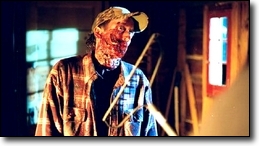 DL: It has been said many times, but film is truly a collaborative art. As you make a film, you surround yourself with talented people in every department. In my opinion a director needs to have a strong vision of the film he or she wants to make but would be a fool not to be open to the ideas presented on the set. As I’ve joked in the past, you’re going to get all of the blame or all of the credit anyway, so you might as well just make it as good as it can be and not worry too much about who came up with what idea. I got huge amounts of input from my producers, my cinematographer, my effects and art departments, and my actors.
In terms of the input of actors specifically, I got a lot of pleasure out of the process of choreographing the scenes with them. You envision things in a certain way, but when you get onto the set and start working it out with the talent it can change enormously. It’s a huge help to have actors who are engaged in this process, can articulate what feels natural for them, and still understand the technical demands of filming. It’s also wonderful to have an actor who feels somewhat responsible for their character. I certainly wrote a couple scenes in the film that, while fine individually, in hindsight did not fit within a character’s arc. I really enjoyed talking through these scenes with the talent and reconstructing them in a way that worked for the characters. Often an actor’s comments or questions can be the catalyst for a mediocre scene being reworked into a great one.
SV: Did you envision the character "Randy" (played by Dennis Lemoine) to be a total "dick" as Dennis describes him or did you envision him to be as likable as Dennis made him?
DL: I wrote the character to be a bit more of an intimidating presence than he ultimately became. The initial idea was for him to be the scariest redneck in town. I wanted someone who was so over the top in their propensity for violence and disregard for human life that they became funny. The sort of person who is almost a caricature of themselves. What I found was that there were very few actors who could act the heavy and also had a sense of the humor of the character. When Dennis came in, he was so funny and eccentric in his performance that it really made me rethink the role.
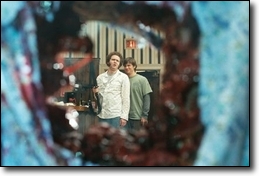 SV: Brynn Lucas, who plays Jake's love interest Alex, said that she gained a lot from the New York actors. Coming from L.A. did she add her own unique perspective or acting style that helped?
DL: All of the actors brought something uniquely their own to the project. Dennis, for example, had an innate understanding of the humor of the piece. Adam, on the other hand, was easily the most cerebral in his approach to the role. He gave a huge amount of thought to his character’s arc and would keep me honest if I wrote something that didn’t fit. Brynn brought a huge energy. There was literally nothing we could ask her to do which she wouldn’t embrace 100%. When you’re dousing actors with freezing water and fake blood on a 30 degree night, that’s invaluable.
SV: In Dennis Lemoine's hair really fake?
DL: That hair is all Dennis.
SV: And finally, any plans for another film with you as Writer and/or Director?
DL: As of right now, I have a new script which I’m very excited about (also a horror film). The next step is working on financing and trying to get it off the page and onto the screen.
Zombie Town is available on DVD at any retailer that doesn’t suck too hard. The website for the film (Where you can get news, synopsis and trailers) is http://www.zapatosfilms.com/ .
Do yourself a huge favor and check this awesome addition to the zombie genre out!
|