|
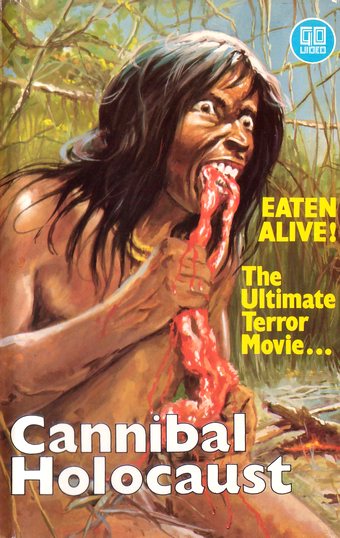
Cannibal Holocaust (1980)
Starring Robert Kerman, Francesca Ciardi & Gabriel Yorke
Directed by Ruggero Deodato
Written by Gianfranco Clerici
|
In the heart of the Amazon jungle, a primal, cannibal tribe lives. They eat animal and, yes, human flesh to survive the hot humid surrounds. Natives enjoy their macabre array of munchables amid the primordial habitat, while military men swarm the edges of their domain, shooting all they encounter. A television journalist interrupts this pastoral scene, reporting that four filmmakers had gone missing in this hidden hell. They had, only a few days earlier, journeyed into that very jungle to make a documentary about life in the Amazon. Brave viewers, welcome to the jungle.
Cannibal Holocaust, a classic horror film, continues as we meet anthropologist Harold Monroe (Robert Kerman), our protagonist journeyman, who ventures into the humid Amazon in search of the missing filmmakers. As he travels with his guide Chaco (Salvatore Basile), soldiers introduce them to a young captive currently serving as bloodhound, erstwhile patsy and future negotiator. The adventure winds through the jungle, the search for the so called civilized and against the so called primitives. It continues through a path so dark and deep, to the core of the "green inferno." After obtaining the bare minimum provisions, they encounter beautiful creatures, wildlife that populates most of the jungle. Continuing with their mission, they stop to relax only once, where they give the captive boy a concoction of cocaine (shot) and possum stomach (fed) and, with a wide open-mouthed smile, he shows that he is content.
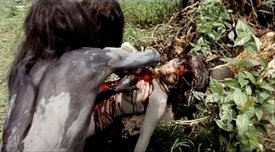
As the gang travels on, a native warrior from one of two rival tribes, the Yacumo tribe, (the other native tribe is the Shamatari who are vicious cannibals as well) subjects a woman to an excruciatingly brutal punishment for adultery. This is a bit more explicit, but probably an apt, primitive, and permanent version of the so-called Scarlet letter. Harold, Chaco, and their captive wait to make their move to save the day, an unsuccessful action based on sheer disgust, fear and human instinct. Harold jumps up as if to run onto the sandy beach and save the woman, but is persuaded by Chaco to hold off. After the bizarre ritual is complete the warrior drags her lifeless naked body to the boat that they arrived in and pushes her out into the tan murky water. He is then shot at by Chaco and runs off, petrified, into the wilderness. And as many great horror films teach us, we may face our fear, we may be intrepid, we may act as heroes and rescuers, but in the end, we all fail. The upshot of this travail is that our protagonists find not the filmmakers, but the film, a documentary that shows their demise.
 The negotiation begins as another man that is with Harold and Chaco takes the captive to negotiate. He gets poisonous darts shot below his feet without even flinching and then moves forward and scares off the large group of locals that are ducking behind shoulder length grass.
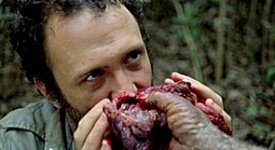
The searchers then come bearing gifts for the chief of the cannibal community. They offer a switchblade and a voice recorder with the chiefs ritualistic moans and chants on it which results in them getting the tribe's respect. They then share a feast of some type of raw organs, shortly after they discovered the filmmakers' gear and cameras.
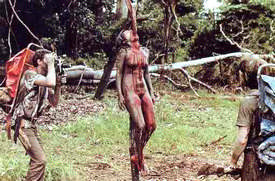 Upon arrival back home, Harold goes to view the film with a group of other journalists and discovers some horrific details that depict arson, murder, deceit, and rape, all inflicted by said filmmakers in order to make a more interesting and real documentary. We view the crew of Alan Yates, Alan's girlfriend Faye Daniels, Jack Anders and Mark Tomaso, as they all commit disturbing acts of murder and torture. They rape a local woman to see the adultery punishment, which ends up being a stick inserted in one end of her body until it's protruding out the other. They act believably shocked and concerned at the brutal act of violence that they were the cause of. The young movie makers burn down multiple handmade cottages, and kill a neighborhood pig as well as many other harmful and destructive acts.
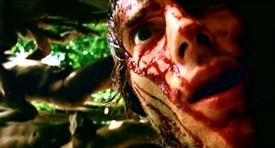 We earlier follow them through an identical path to the one that Monroe had also taken, both ending with very different results. Murder, rape, torture, and getting barbequed is what's in the near future for these absent auteurs. There extreme acts of cruelty and hate are not taken kindly by the hungry tribe. They retaliate and as the documentary comes to a close we see Faye Daniels being beaten and raped by the entire tribe. When she is defeated and decapitated they go after the camera operator, at this point, Alan Yates and the last shot of the ever so believable phaux-documentary is Alan lying bloody and on the last few seconds of his life. We then see Harold's reactions to these stunning, bizzare, and unbelievable images he has just viewed. In disbelief we view him exiting the building and lighting his pipe. A brutal end to a brutal movie.
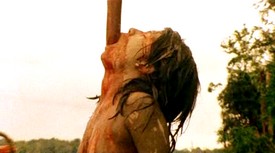 This film shows Ruggero Deodato's true directing abilities. While many parts are sickening and truly disturbing, this movie was brilliantly filmed. Varieties of film stock and beautifully constructed shots are hallmarks. The content of bloodshed, rape, killing of animals, cannibalism and brutal murders can certainly be inferred by the film's title. The film, shortly after it was completed, was taken and Deodato was arrested. The film appeared so real that it was thought to be a snuff film. However, Deodato was acquitted of all charges when the actors showed their faces. Good acting is not what's to be expected in an 80s grind house movie but, surprisingly, the actors do a fantastic job. The protagonist, anthropologist Harold Monroe, is played by Robert Kerman. He aptly portrays an intrepid crusader, gaining the respect of the natives and discovering what has become of the lost filmmakers. As this movie opens overlooking the beautiful Amazon jungle, the theme plays by composer Riz Ortolani. This sets a serene tone to an ominous picture. The score remains interesting throughout the film. Overall, the film seems so believable, with a fascinating shift to shooting with video cameras during the second half, that it makes for a truly frightening, real, and disturbing experience.
|
 jake
jake