|
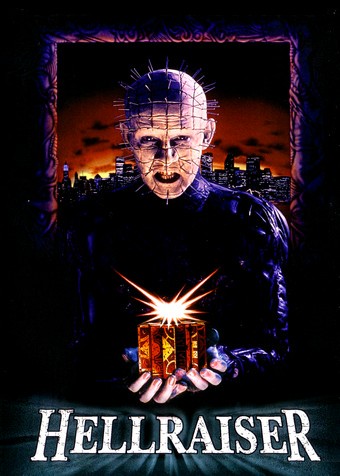
Hellraiser (1987)
Starring Doug Bradley, Sean Chapman & Clare Higgins
Directed by Clive Barker
Written by live Barker
|
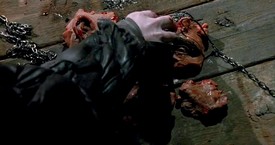
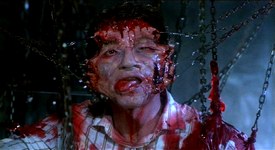
A man sits alone. Aside from the square of candles around him, there is no light in the room. His face is rough and unshaven, his body glazed in what may well be a few days worth of sweat. Calmly but obsessively he thumbs at the object in his hands, the ornate puzzle box. What is it about this thing? Sure, some people get hooked on crosswords or soduko, but this goes way beyond that. This is obsession. This guy is determined not to move from that spot until he solves the puzzle. And soon enough, for his trouble, he has numerous hooks digging into his skin, ripping him apart.
Obsession. Compulsion. Desire. Despair. Flesh. Blood. These are the heart of this unique, iconic film. It’s safe to say that Hellraiser is a little bit more than your average 80’s low budget horror movie. Not that I was conscious of that the first time I saw it aged eleven or twelve, nor was I aware of the significance it would come to have for me. At that point, all I knew was that it had a crazy looking monster called Pinhead on the video cover, who I’d ascertained was kind of like Freddy, but weirder. I didn’t know that there was anything more to it than that. I probably didn’t know, as a lot of people still seem not to realise, that it was a British film. I certainly didn’t know that really it was less about blood and guts (even though it had those qualities in abundance) than it was about relationships, emotions and adult anxieties. And I didn’t expect when I snuck the tape into the VCR, anxious not to be caught in the act by my parents, that I would be spending the bulk of the next ninety minutes in the company of a woman in her forties rather than the predictable bunch of nubile teens; or that this Pinhead character would only be appearing sporadically.
Indeed, so low is Pinhead’s screentime that, as unthinkable as it might seem now, when given the choice between the part of the Lead Cenobite (as the character was officially dubbed to begin with) or that of one of the movers carrying the bed into the house early on, Doug Bradley seriously contemplated taking the latter. As he says in his book Behind the Mask of the Horror Actor, “this was to be my first movie, so why would I want to be buried in latex? Who would be any the wiser? Much better to make the briefest of appearances and be seen. All sensible, actorly reasoning ‾ and completely wrong.” (Incidentally, the mover in question would be played by Oliver Parker, who has since enjoyed a successful directing career with adaptations of Othello, The Importance of Being Earnest and the upcoming Dorian Gray.) It seems that no one involved in the production of Hellraiser had anticipated the icon that Bradley’s monster would come to be, not the actor himself, nor the monster’s creator: first time feature director Clive Barker, already a major presence in horror fiction when production commenced in 1987. But while the man with the nails in his cranium may not have been consciously designated a figurehead, there’s no denying the distinct change in mood anytime he appears; and, as his is the next face we see after the ill-fated Frank in the opening minutes, the viewer is left anxious to see this chilling, fascinating creature again. Like the shark in Jaws or the Xenemorph of Alien, Pinhead may not actually appear all that much, but his presence can be felt at all times.
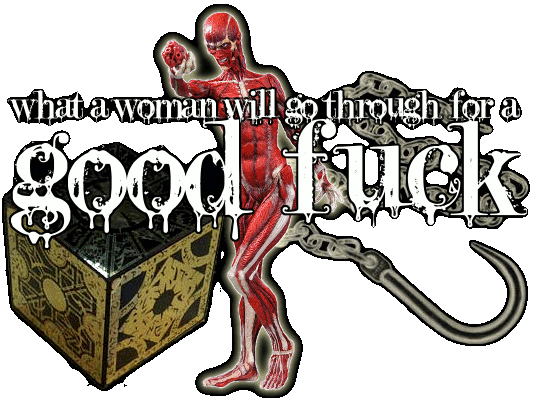
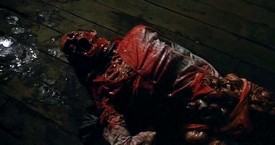
 And yet, Hellraiser is not the story of Pinhead, the Cenobites, or even Frank. Nor is it the story of Frank’s brother Larry, the nominal lead thanks to the casting of Andrew Robinson, at the time the biggest star in the ensemble. No, the real central character from whose perspective we are told the bulk of the tale is Julia (Clare Higgins), wife of Larry and one-time lover of Frank. She is feeling trapped and lost, disillusioned with her marriage and longing for the forbidden thrill she once knew with Frank, when suddenly the opportunity to experience that once again arises - albeit in a horrific, reanimated dead tissue kind of way. Frank is still alive, though little of him remains. He needs human blood in order to regain his full human form - and he needs Julia to get that blood for him. And so, while Frank’s explorations into the limits of experience may have kicked things off, it is the dilemmas that face Julia and the decisions she makes that really set proceedings in motion. And also the reason behind the alternate title above, which Clive Barker says was suggested by a woman on set when New World Pictures expressed doubts about calling it Hellraiser. English ladies; so prim and proper, don’t you know.
It hardly needs to be said how rare it is for a bona fide grown up to take centre stage in a film like this, the kind of film that so often gets dismissed as ’kid’s stuff.' This unusually adult angle is a good part of what makes this so unique a film. And perhaps the real secret of Hellraiser’s enduring power; by making us directly identify with this middle-aged woman and her midlife anxiety, the viewer is complicit when she chooses a murderous course of action. We are forced to ask ourselves ‾ when it came to someone or something you desired so overwhelmingly, where would your limits lie? And, as previously stated, the very nature of desire itself is a central question. In a flashback scene we see Julia and Frank, lying together in the aftermath of the best sex Julia has ever had, when Frank abruptly gets up, furious, complaining, "It’s never enough." Just what is this need that he seeks to fill by finding the Cenobites? Surely it’s the same need Julia thinks she can fill by having Frank back. It is a hunger that is so deep, so crippling that it goes beyond the sexual. It goes into places beyond our level of reality, and into the dark, primal state of being that is the netherworld of the Cenobites. Can such a need ever be truly satiated? And ‾ as Frank finds ‾ if we do obtain the thing we’re after, will it turn out to be what we wanted it to be? Do we really know what we want? And, of course, the questions probably most associated with Hellraiser ‾ is it pleasure or pain we seek, and just where does the line between the two lie?

Yes, most of this went over my head on first viewing. Back then, I was probably anxious for a bit more of Ashley Lawrence’s Kirsty onscreen, preferably with a bit less clothing. She’s a pretty young thing, no doubt about it. But watching Hellraiser again now, I can’t help but find her character the least interesting part of the film. Very much fitting the Final Girl archetype, it is in her scenes that the film descends from bizarre psychosexual melodrama to fairly conventional slasher, and as such something considerably less unique. That said, the climactic stalk ’n’ slash sequences are brilliantly realised. It’s at this point, once taking over the role of Frank beneath Larry’s skin, that Andrew Robinson really comes into his own, giving a gloriously unhinged performance overflowing with sadism and perversity (and, for my money, easily leaving his infamous turn in Dirty Harry in the shade). And once the Cenobites show up again, conventionality is most definitely no longer an issue, and we’re in for some of the most nightmarish, unforgettable imagery in horror film history. Having already cemented himself as one the era’s greatest writers of horror fiction, Clive Barker more than proved here that he had the talent and vision to also become one of the all-time great horror directors. What a pity that never came to be, but I guess his many brilliant novels are sufficient consolation.
Of course it was inevitable that conventionality would creep back in with the expansion into sequels. Hellbound: Hellraiser II is entertaining enough, Tony Randel’s direction carrying on much the same tone and aesthetic as Barker’s film whilst upping the ante even further for brutality. But the story is a mess, and the characters mere shadows of what they had been. Julia, a complex and sympathetic protagonist in the original, is reduced to a two-dimensional villainess (sure, a little time in hell might change a person, but still...). And let’s not even get started on how feeble the original Cenobites wind up being, in the horrendously sentimental discovery of their human origins: "Remember your confusion!" pleads Kirsty. "Pass the fucking sick bag," say I.
 And then came Hellraiser III: Hell on Earth... and the franchise was never the same again. As New World collapsed and Dimension Films snapped up the rights, production moved from Britain to America. In the process, genuine chills gave way to gore-gag belly laughs, Gothic gloom gave way to poodle metal, and multi-layered adult characters gave way to... gasp... JP Monroe. Now don’t get me wrong - I really like Hellraiser III. It’s a great bit of cartoonish fun that doesn’t take itself too seriously. But the series began as so much more than that, something genuinely innovative and sophisticated. How the franchise fared beyond that I couldn’t say, as that’s as far into the series as I’ve watched; of the five further sequels only the forth and fifth instalments, Bloodline and Inferno, have been released in the UK to my knowledge. Charming - the country that gave birth to the series is denied access to its more recent entries. Though I’m given to understand we’re not missing that much.
But you know what? I’m going to say something now that we really need to say more often: fuck the franchise. It doesn’t matter. And the same goes for the remake that has been languishing in development hell (appropriately enough) for the last couple of years: fuck that too. No sequel, prequel or remake, no matter how bad, can ever really detract from a great movie. Jaws and Alien didn’t suddenly become suck-fests the day Jaws: The Revenge and Alien: Resurrection were released. The Texas Chainsaw Massacre hasn’t lost its unspeakable primal ferocity because of the Platinum Dunes rehash. As horror fans, we take it personally because of what the originals mean to us, but the films don’t lose that intimate, personal meaning just because someone revisits the source material in an unsatisfactory way.
Hellraiser has come to mean a great deal to me personally for a number of reasons. Indeed, without it, it’s conceivable that I wouldn’t be where I am now or doing what I am currently doing. For starters, had I not sat up one evening during high school to watch it with a lovely young lady who was not yet my girlfriend, feeling her crawl further into a ball at my side as the film progressed, perhaps that same woman would not today be my wife. And if I hadn’t had the good fortune to attend a public appearance by Doug Bradley in 2004, it’s probable I wouldn’t be writing this, for it was that evening that made me decide to become a writer. Bradley was promoting the aforementioned Behind the Mask of the Horror Actor, and giving a lecture modelled around its contents, covering the history of make-up and masks up from primitive cultures to theatre to the advent of creature features, and finally dealing with his own experiences as a movie monster. How fascinating it was, seeing a guy of about the same age as my parents, speaking with true respect, enthusiasm and eloquence about a subject that is so often looked-down upon by the middle-aged and middle class. All of sudden, I didn’t feel quite so weird for being into horror movies anymore. And then, to end the talk, Bradley quoted the closing lines of the book: “Many more monstrous delights lie in store for us, and I, for one, look forward to finding out who will be the new men and women behind the ever-changing mask.”
Well, I thought. The gauntlet has been thrown down. I’d better get to work. And if ever I manage to write something that comes close to carrying the power of Hellraiser, then I’ll be able to consider myself a success.
|
 ben
ben