|
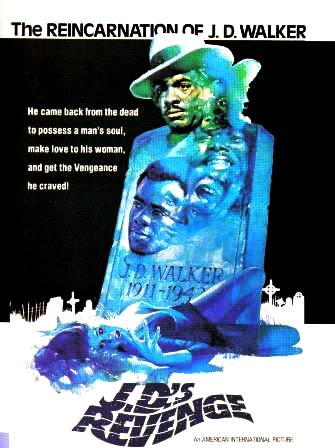
J.D.'s Revenge (1976)
Starring Glynn Turman, Louis Gossett Jr. & Joan Pringle
Directed by Arthur Marks
Written by Jaison Starkes
|
New Orleans is a city that has risen time and time again; from the ashes of the great fire of 1788, the Battle of New Orleans in 1815, and the ravages of Hurricane Betsy in 1965, and the tragedy of Katrina in 2005. As a frequent visitor to The City That Care Forgot, I can say that slowly the people are beginning to come back, and the city is once more rebuilding from tragedy. In a place with such a long tradition of resurrection, it seems natural as a setting for a tale of a spirit returning from beyond the grave to seek it's revenge.
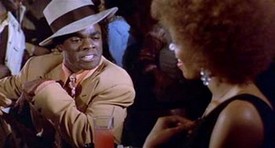 In the 1940's, J.D. Walker was a slick gangster running numbers in the Crescent City, and he was gunned down after being falsely accused of murdering his own sister. Thirty years later, Ike is a happy go lucky kind of fellow living his life in the French Quarter with his girlfriend, Christella. Ike works long days as a taxi driver and studies by night to become a lawyer, but one evening Christella talks him into going to celebrate their friend's one year anniversary. They have a fine time at a topless go-go bar, but when they attend a hypnotist's show and Ike gets put under, he begins to share his body with the spirit of J.D. Walker.
Ike begins to suffer from headaches and has visions of the events leading up to the gangster's demise. Slowly, his very character becomes overtaken by the swaggering misogynist, and he begins to act out on J.D.'s dark impulses. This includes a growing hatred of the good Reverend Elijah Bliss (Gossett) and his brother Theotis. As Ike begins to lose control of his will to the evil spirit, the true events that lead up to J.D.'s death become revealed, and his spirit will not rest until his vengeance is fulfilled.
The amazing thing about this film is that it doesn't fall into the trap that many blaxploitation horrors of the era, such as Blackula, fell prey to. Ike and Christella are fully realized characters, normal, average people and not the cartoonish caricatures that populate so many films of the period. This is thanks to a great script and a well directed cast, but more than that, the acting in the film is superbly nuanced. Turman (Cooley High, Gremlins) has the biggest job in the film, and his duel portrayal of the nebbish Ike and larger than life (or death) J.D. is what really makes the whole film work. While J.D.'s character is painted in broad strokes, it seems infinitely believable that a New Orleans' gangster from the '40's would act in such a manner.
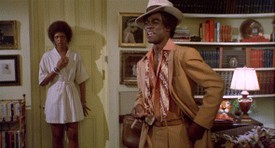 The other great performances in the film come from a young Lou Gossett and David McKnight. Years before Iron Eagle, Gossett's turn as the charismatic preacher Rev. Bliss is a scene stealing performance. Sadly, the film drops in few clues to the Reverend's past and perhaps nefarious reasons for becoming a preacher, but those avenues never get explored. (In recent years, Gossett has reconnected with New Orleans as the producer of the post Katrina documentary, ReNew Orleans) McKnight, who played the titular J.D. in flashbacks and Ike's visions, shows a gravelly menace which heightens the tension of Ike's plight. McKnight is still a working actor to this day with roles in the 1990 underground radio opus Pump Up the Volume and the 2008 spoof Superhero Movie.
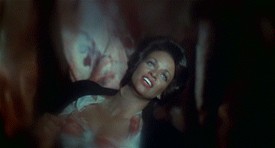 J.D.'s Revenge also has a very slick, well produced look. Director Arthur Marks, who filled the big chair for films like Detroit 9000 (1973) and Bucktown(1975), re-teamed here with the same cinematographer of both of those films, Harry May. While the flick lacks for blood and on screen violence, it succeeds in providing an excellent atmosphere. Slow pans and well placed zooms interlaced with footage of slaughterhouse gore all add to the film's eerie feeling. The one drawback is the lack of any real gore. Roy L. Dowery was in charge of the special effects, and while the over red blood is quite special, it is hard to imagine Dowery being behind the effects in films such as the 1988 Blob remake and 2008's Rambo.
When I see a film set in NOLA, there are several conventions that usually are de rigor for the setting, and it was a welcome relief that none of them made an appearance here. It was not Mardi Gras, there was no voodoo, and not a dirty cop or politician was to be found. What you do get is a good bit of footage of the French Quarter in the late '70's. Bourbon Street is on full display with the same proliferation of bars, strip clubs, and gift shops that you can still find today. The hypnotists' show is housed in the Famous Door bar located on Bourbon Street, and so named for the numerous celebrities that have crossed it's threshold. We also see Ike getting beat up in back of St. Louis Cathedral and visit J.D's grave in the infamous St. Louis No. 1 Cemetery, the real life resting place of voodoo queen Marie Laveau.
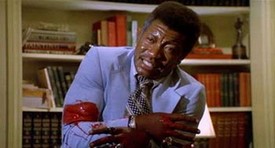 J.D.'s Revenge is a flick that worked for me on a lot of levels. First by making a film that felt less like exploitation and more like a film that happened to have an all black cast, making it is easily one of the better films in the sub-genre. Next, the story by writer Jaison Starks, the pen behind the star studded basketball comedy The Fish that Saved Pittsburg (1979), has themes that almost give a Shakespearian tone to the tragedy. These elements coupled with some fine acting and directing, make this an overlooked gem that probably suffers in popularity by not being a stereotypical black film. I would highly recommend watching J.D.'s Revenge and give the work the recognition it deserves.
|
 t.l. bugg