When Bram Stoker introduced a new supporting character in Chapter five of Dracula, he begins with a simple statement "R.M. Renfield, aetat 59. Sanguine temperament, great physical strength, morbidly excitable, periods of gloom, ending up in some fixed idea I cannot make out." Little did Stoker know at the time, he had not only created the iconic creature Dracula, he had also come up with another character so fascinating that he will be forever linked to the Count. Stoker had created Renfield, a man of a shadowed past who had formed some kind of psychic link to Dracula. He dined on bugs and schemed to take the life from larger animals. Renfield had moments of mania, bloodlust, and compassion, but unlike all the other major players in Stoker's novel, we only learn what we do of Renfieldfrom words of others and never his own.
Since then Renfield has appeared on film time and time again, and these portrayals have shaped the nature of the character in the public consciousness. It has become a role much remembered for its many screen incarnations and played by character actors, moody thespians, musicians, and comedians. Each time the character of Renfield had a little more brought to it, from subtle changes to massive rewrites, Renfield became both a product of his history and the actors who bring Dr. Seward's "pet lunatic" to the silver screen.
 The first incarnation of the Dracula story to hit the screen was, of course, the silent F.W Mureau classic Nosferatu. In an unsuccessful effort to avoid prosecution for copyright infringement, screenwriter Henrick Galeen made many changes to the original story. One of the parts that did not make the cut was the character of Renfield, and the public would have to wait until 1931 to see the madman take the screen.
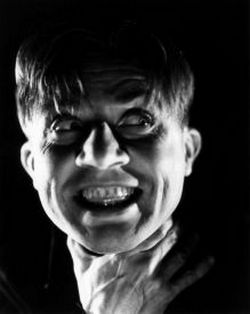
In Tod Browning's production of Dracula, Browning tapped Dwight Frye as his Renfield. Frye, who had only had a couple of minor roles in gangster pictures, was nearly a complete unknown to the movie going audience, but he would become the actor most often connected to the role. Frye played Renfield with the same wild-eyed stare which would become his trademark throughout the rest of his career. In Browning's film, Renfield is given a back-story for the first time. Allowing for the psychic connection to Dracula later in the film, Renfield's story includes him preceding Johnathan Harker to Castle Dracula and becoming the Count's slave. This not only clears up the connection between Dracula and Renfield; it has also become the most known origin story of the character in popular
culture.
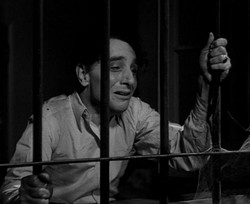 Also in 1931, Pablo Alverez Rubio brought his version of Renfield to the screen when director George Melford filmed a Spanish language version of Dracula at the same time as Browning's. While many people see this as a superior version of the film, the absence of both Lugosi's menace and Frye's maniac do the film a disservice. Rubio does a fine enough job with the same material as his American counterpart was working with, however his performance feels uninspired and underwhelming. Comparing Rubio's understated performance with the insane glee Dwight Frye brought to the screen, I cannot see how many would be impressed with this Renfield.
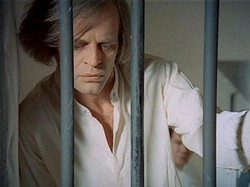 It would be almost 40 years before Renfield graced the screen again. The Hammer horror versions of the Dracula legend left out the Count's psychic servant, and after several films, Christopher Lee hung up his fangs. Then in 1970, Jess Franco wooed Lee to Spain to don the cloak of Dracula one last time by promising to bring a faithful version of Stoker's book to the screen. While the success of Franco's El Conde Dracula may be debatable, Klaus Kinski's silent performance as Renfield is surely a major feat of acting. With this telling, instead of creating a back-story for Renfield, Franco and Kinski keep the man's past shrouded in mystery. Never uttering a single word, Kinski manages to tell us everything we need to know about the character: insane, bloodthirsty, and somehow connected to the Count. The defining moment of Kinski's portrayal comes when Renfield sneakily brings out a box of flies to eat while he thinks the jailer is not looking. The furtive glances that Renfield casts and the methodical way he portions out his tiny meals, both speak volumes of the character without a word being spoken. For an actor like Kinski, whose vocal talents gave him his start, it was a risk to play Renfield as a mute. However, it keeps the character's past and motives a complete secret, and it turned out to be a bold and effective choice.
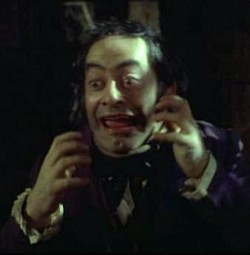 Nineteen Seventy-Nine might have been the biggest year for Dracula and Renfield since 1931 with two versions of the character making it to the screen. First, Director Walter Herzog teamed with none other than Klaus Kinski to remake Mureau's Nosferatu. Unlike Mureau, who was trying to avoid the wrath of Bram Stoker's widow, Herzog could make use of the original material and graft some of it back into the tale, so Count Orlock becomes Count Dracula and Renfield becomes the agent who dispatches Harker to Transylvania. French actor and writer Roland Topor, who penned Polanski's The Tenant, takes over the role this time, and Herzog chose Torpor for his very distinctive and maniacal laugh. From the moment we meet Torpor's Renfield as he sends Harker into the Count's clutches, there is something not quite right about the man. By the time Harker returns from Transylvania, Renfield has succumbed to insanity and is a patient of Dr. Seward. Torpor's laughter indeed does make the man seem genuinely insane, and the performance is chilling in it's realism of a man whose mind is no longer fully in his own control.
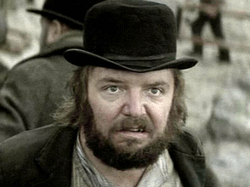 Next, Tony Haygarth, a stalwart British character actor, also took a turn at the character of Renfield in the 1979 interpretation of Dracula, directed by John Badham, who had just helmed Saturday Night Fever, and starring Frank Langella. Haygarth appears here as Milo Renfield, a laborer who goes insane after encountering Dracula at Carfax Abbey. Haygarth's Renfield seems at first to act as a comic foil to the Count, but he does take a dramatic turn when he realizes he is under the vampire's spell. Renfield's character has precious little screen time in this version, and only a short monologue before his demise. His character has almost nothing to do with the Renfield of the novel or of previous films other than his sycophantic relationship with Dracula.
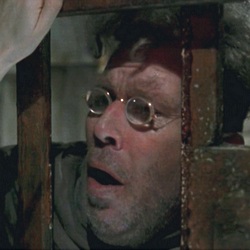 Then in 1992, Francis Ford Coppola took his turn at adapting Dracula for the big screen. With a cast that varied wildly from the sublime, Anthony Hopkins as Van Helsing, to the sadistic, Keanu Reeves as Jonathan Harker, the troupe that Coppola assembled filled their roles with varying degrees of success. Renfield however is one of the success stories. Here the part is filled by sometimes actor and all times singer/songwriter Tom Waits. This time we are told he is the agent who preceded Harker to Count Dracula's castle, and when he returned he was utterly mad and confined to Dr. Seward's care. Like so many of the men who have played Renfield, Waits arrives on the screen with his own very distinctive look. With his unkempt hair and beard and Waits' trademark gravelly voice, this Renfield seems like he might be the most rabidly insane of all the Renfields. He thrashes and screams, and at one point, he is restrained in a very interesting looking straightjacket. Yet there is still something about the softness in Waits' eyes which gives his Renfield a touch of humanity that no actor, except perhaps Kinski, has matched.
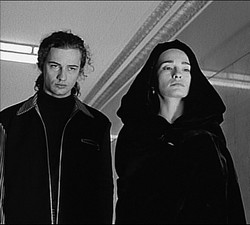 The last Renfield I would like to discuss is played by Karl Geary in the film Nadja. This was Geary's first film, and his career has not improved much since, unless you count a turn as Steve Clark of Def Leppard in a 2001 TV film adaptation of the band's career. Directed by Michael Almereyda, this film follows the plight of Nadja, Dracula's daughter, as she attempts to relieve herself of the vampire curse. It features a performance by Peter Fonda as well as an amusing cameo by director David Lynch, who was the producer of Nadja. Geary's Renfield is the cool, calm and collected slave/protector of Nadja who seems harmless, but he ends up being quite dangerous when provoked. Nadja amounts to an art house reworking of the 1936 film Dracula's Daughter, but in its Lynchian artfulness makes it a welcome addition to the vampire and Renfield mythos.
In the future, who can tell what will become of the fly eating character we've all come to know? With The Wolfman getting a reboot this year, can Dracula be too far behind, and who will step into the shoes of Renfield? As of late (and due to The Watchmen), I would be pulling for Jackie Earl Haley or a perennial creepy favorite like Crispin Glover. Whichever actor takes the part will be following in a line of screen Renfields that go back nearly eighty years now. I'm sure, just as the actors who have previously taken on the role have done, whoever fill the shoes of Dracula's servant will leave their own mark on the role. One which will surely add to the deep, rich history of this classic film character.
|
 t.l. bugg