The story of Waldemar Daninsky, sometimes a Count, sometimes not, really starts when an eleven year old Jacinto Molina is taken to the cinema by his mother to see the Universal classic Frankenstein meets the Wolf Man [1942] at the height of his native Spain’s ultra-repressive Franco era (that’s General Franco, not Jess!). This chance viewing triggered a lifelong obsession that started with numerous drawings as a child and culminated in his writing a screenplay for his own werewolf movie – with none other than Lon Chaney Jr. in mind for the lead role.
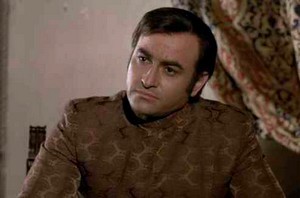 When it turned out that Chaney wasn’t available, one of the German producers persuaded Jacinto, a bodybuilder and architect who’d had small roles in films like Nicholas Ray’s biblical epic King of Kings [1961] to take the leading role. He eventually agreed, taking on the new mantle of Paul Naschy, little suspecting he would still be acting in horror pictures forty years later. Although Naschy has made many other horror movies worthy of mention his Hombre Lobo movies featuring the character Waldemar Daninsky are the focus here.
In El Marca del Hombre Lobo [1968], better known to English speaking audiences as Frankenstein’s Bloody Terror (AKA Hell’s Creatures). Mary Shelley’s creation is nowhere to be found – American producer Sam Sherman had promised his distributors a Frankenstein picture and wasn’t able to deliver. One cheesy animated intro with a voiceover hastily explaining how the blood of the Frankenstein line had been tainted by a werewolf later and hey presto! One Frankenstein movie!
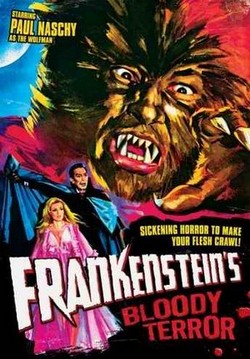
However, despite being bereft of lumbering composite creatures, it is a highly enjoyable monster mash. Two young lovers, Rudolph and Janice visit the ruins of Castle ‘Wolfstein’ (at least in the American version) and run into Waldemar, who tells them that the last of the Wolfstein line was under in the grip of the curse of the werewolf. Later, a gypsy couple stumble into the castle’s crypt to escape a rainstorm, find some dusty bottles of vintage wine, get wasted and decide it would be fun to pull the silver cross out of the corpse of the last of the Wolfsteins. You can guess the rest.
The next thing you know, the local townsmen, including of course Waldemar and Rudolph, are out hunting for the creature. They become separated from the rest of the group and when Rudolph is attacked by old Wolfstein, Daninsky rushes to save him and kills the creature – but not without becoming clawed and hence afflicted with the curse himself.
Now it’s Waldemar’s turn to go roaming the countryside and it’s not long before he has claimed his first victims. Full of remorse in true Larry Talbot style he turns to Rudolph and Janice for help (doesn’t he know anybody else? He only met them, like, five minutes ago). At his request, they chain him up in the cellar of the castle. Finding an old journal, they come upon the name Dr. Janos Mikhelov – who in the past had apparently tried to find a cure for old man Wolfstein. Janos soon turns up with his glamour-puss wife – but wait! Doesn’t he look a bit young for someone written about all those years ago? And – why does he look and dress a bit like Dracula? Oh, let me see - because he and wife are goddamn vampires, that’s why. And they’re not here to help matters.
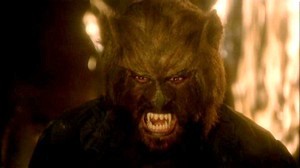 One can see why Frankenstein’s Bloody Terror did pretty well internationally. Colourful, fun and harking back to the great universal classics, it must have been great seeing it at drive-in. It was an absolute smash in Naschy’s home country.
This quickly led to the production of a sequel in the very same year. However, Las Noches del hombre lobo [1968] is officially a ‘lost’ film and nobody seems to be able to find any evidence that it actually exists - or at least that it was released. Naschy maintains that it was the story was about an evil scientist using a werewolf-cursed student (presumably Waldemar) to his own nefarious ends. As time goes by, it appears increasingly unlikely that anyone is ever going to see this.
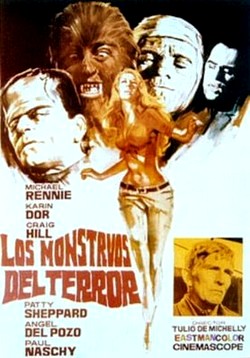
Whatever happened with that one, 1969 saw Waldemar return in Los monstrous del terrore, better known to English-speaking audiences as either Dracula vs. Frankenstein (not to be confused with Al Adamson’s, er, ‘classic’) or Assignment Terror. This one has to be seen to be believed. Aliens from the planet Ummo, led by none other than Klaatu himself, Michael Rennie, take on the personalities of some dead scientists and hole up in a fairground. After pulling the stake from a Dracula-esque vampire they find there, they hatch the diabolical plan of travelling to Transylvania to resurrect creatures they learn about in ‘Dr. Faranksollen's Anthology of Monsters’ – namely ‘Faranksollen’s Monster’ (you guessed it – but in the worst make-up you have ever seen), a mummy and, of course, wolfman Waldemar. The basic idea is to scare the shit of earthlings in order cow them into submission.
If this all sounds vaguely familiar, it’s probably because you’ve seen Plan Nine from Outer Space [1959]. Anyway, needless to say, Waldemar breaks free of the aliens’ control and turns against them and the other monsters, resulting in what is best described as a monster Wrestlemania. Unlike the first in the series, this cracker is set in the ‘present day’, so, it being 1969, we are treated to groovy fashions, psychedelic lights and cheesadelic music. The Groovy Ghoulies Get Together was never this much fun. Unlike others in the series, this has never seen a proper DVD release, but bootleg DVD-R versions are available from RetroMedia and others.
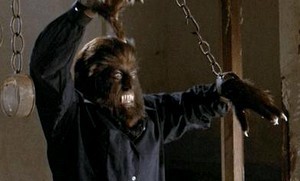 One common thread the Daninsky series has is a total disregard – nay, disdain even – for any kind of continuity. When we catch up with our hairy friend again, in La furia del Hombre Lobo [1970] – AKA Fury of the Wolfman, AKA The Wolfman Never Sleeps – he is a college professor and has apparently contracted the werewolf curse by being bitten by, wait for it, A YETI, whilst travelling in the Himalayas. When he finds out that his wife has been playing away from home and is plotting with her lover to kill him, he loses it big-time and the titular ‘fury of the wolfman’ is unleashed upon her and her bit on the side. However, Waldemar soon manages to get himself inadvertently and fatally electrocuted (don’t ask). Surely it can’t end here... and it doesn’t. Waldemar’s campus colleague Dr. Ilona Elmann, is soon digging up his corpse, reviving him and using him for mind control experiments – as well as using him as a pet dog to get rid of anyone who gets in her way.
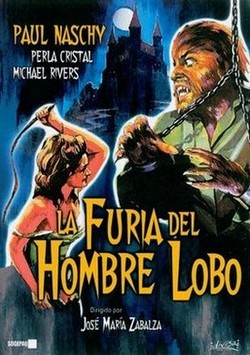
Fury of the Werewolf is not quite so much as a mess as Assignment Terror, but it comes close and is almost as much fun. The problem lies again with Naschy trying to throw far too many elements into one story. Much more focussed is my personal favourite of the series, La Noche de Walpurgis [1971] (AKA Werewolf Shadow, AKA The Werewolf vs The Vampire Woman, AKA Blood Moon). This was the first of several times that Naschy worked with the director León Klimovsky and marked his biggest international success to date.
The film begins with a dead Waldemar lying on a coroner’s slab, with two doctors examining him. Laughing at rural superstitions, one of the enlightened men of science thinks it’s a great idea to pull the silver bullets from his chest – within half a minute El Hombre Lobro is back in business and their asses are grass. The creature then lopes off into the woods, savaging a local village girl on the way for good measure. Cue cheesy (but somehow strangely sublime) title music and opening credits.
Cut to Paris, where we are introduced to Elvira, a glam redhead who is writing a thesis about black magic and vampirism (not a course listed on the syllabus of my local university, more’s the pity) and informs her boyfriend Marcel that she and her pal Genevieve plan to travel to a remote French village to find the tomb of medieval aristocrat, murderer and reputed blood drinker Countess Wandessa.
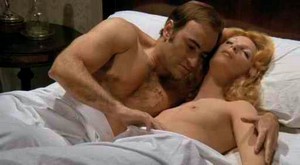 Arriving at Wandessa’s former stomping ground, it’s not long before they encounter our tragic hero, who offers them lodgings in his castle while they carry out their search. It’s not the greatest of offers, seeing as his castle has no mod cons whatsoever and - oh yeah - has his mentally disturbed, disfigured sister roaming the corridors, but it’s the only one they’ve had. The next day, Daninsky and the girls succeed in finding the Countess’s grave and exhume her corpse, removing the ornate silver cross that killed her and managing to – d’oh! - get some blood on her into the bargain. You would think that Waldemar, being a werewolf and all, would perhaps sense the unwisdom in this.
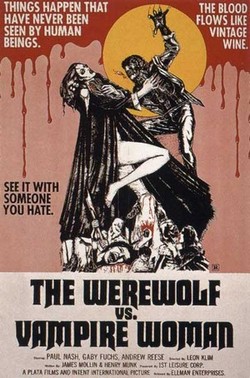
As sure as eggs, that very night, the resurrected Countess is stalking the girls and quickly lures Genevieve away, transforming her into a vampire. As Wandessa tries to ensnare Elvira too, the besotted Waldemar vows to protect her – but as Universal Pictures werewolf law dictates, Elvira must also kill him.
Okay, so the plot does sound kinda dumb, but this is a great creature feature. It’s a hell of lot more atmospheric than the last one, that’s for sure. Whenever the black-shrouded vampires are seen, they’re filmed in slow motion and encircled by a swirling mist - surely ranking amongst the most iconic imagery in Eurohorror cinema - and the music accompanying their visits just sends a pleasurable shiver down the spine. Werewolf Shadow is a great piece of entertainment, even if it does, like many in the series, suffer from what I call ‘Hammer Sudden Ending Syndrome’.
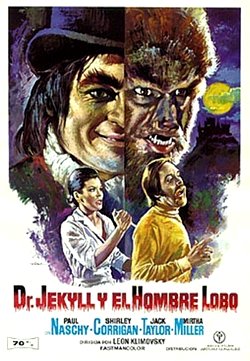
Another classic movie monster entered the Naschy universe with Dr Jekyll y el Hombre Lobo (Dr. Jekyll & the Werewolf) released the following year. This time Waldemar’s home turf is Transylvania, no less, from which he travels to London to seek help from the grandson of Robert Louis Stevenson’s infamous character (played by Jess Franco regular Jack Taylor). Jekyll agrees to help our hero, his utterly illogical plan being to turn Waldemar into Mr. Hyde so the two parts of his psyche can battle it out, somehow leaving Waldemar freed from the curse. Yes, I think I see the hole in this plan, too.
Before you know it Daninsky is roaming the streets of just-about-still-swinging London as ‘Mr Hyde’ complete in mock Victorian top hat and cape (!), strangling unwary hookers with their own stockings. I’m confused: why the hell would he turn into someone who is supposed to be the manifestation of Dr. Jekyll’s darkest desires and not his own? Maybe I’m thinking about it too much. Another enjoyably silly entry in the series, even if it is a slight letdown after its immediate predecessor.
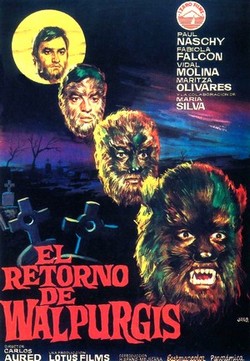
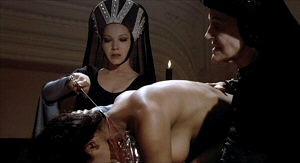 Another movie, another origin story, and in El retorno de Walpurgis [Curse of the Devil, 1973] a brutal medieval ancestor of Waldemar is cursed for eternity by a witch whom he sentences to be burned at the stake. Much later, in what appears to be the 19th century, Waldemar himself, lord of the manor, is out hunting and kills what he thinks is a wolf - but is in fact a werewolf. In the daytime. With a normal pistol. See what I mean about continuity?
Anyway, it transpires that said lycanthrope is a young man belongs to the very gypsy witch-cult who cursed our hero’s family line all those generations ago. To exact their revenge, they hold a ritual at which one of their number, Ilona, gives it up for Satan himself – who appears complete with slinky skin-tight black outfit – and sets out to ensnare Waldemar and ensure he’s cursed forever. Wait a minute, I thought the Daninsky family line was already cursed for eternity at the start of the movie? Oh, whatever.
 It’s not long before Ilona manages to get our lonely Lothario into the sack and, as soon as he settles into his post-coital nap, she sneaks out to collect a bleached wolf’s skull and pierces his nipple with its teeth. Job done, she runs out into the night – only to be chopped down by an axe-wielding psycho! Yes, you read right. Well, there couldn’t very well just be one ‘monster’ roaming around in Naschy werewolf flick now, could there?
Obviously, Waldemar is now a werewolf once more and the usual reign of rural terror begins. The locals all think that the psycho is responsible. He shortly after meets two sisters – who both of course have the hots for him; what woman could possibly resist those Naschy charms? (Did I mention that Naschy wrote all the screenplays?) Whilst it is the elder ‘nice’ sister that Waldemar is interested in, he has no qualms about obliging the younger ‘naughty’ one when she tries to seduce him. But – wait! The full moon approaches…
Curse of the Devil is another of the better entries. Yeah, of course it’s silly, illogical and has plot holes you could fly Battlestar Galactica through, but it’s solid old-school gothic horror entertainment with a generous spooning of that Eurosleaze magic we all know and love. Well, maybe not ‘all’. Thanks to a devious ad campaign, with posters screaming ‘Damn the Exorcist! The Devil won’t let go!’ many American cinemagoers were tricked into thinking they were walking into a demonic possession epic in the style of William Friedkin’s classic of the same year. What they thought when they realised they’d walked into a Spanish werewolf movie I’d love to know.
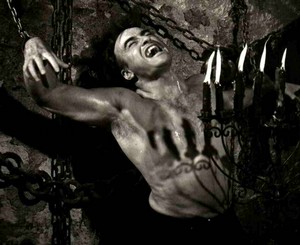 The movie obviously performed reasonably well at the box office, as 1975 saw Waldemar return again in La Maldicion de la Bestia(Night of the Howling Beast, AKA The Werewolf and the Yeti). This time a sideburn-sporting Waldemar accompanies a team of archaeologists -which includes a character called, I kid you not, Larry Talbot - to Kathmandu to find out what happened to previous expedition that has gone missing. By this point, we already know what happened to them – they’re killed by a goofy looking hairy sonofabitch right at the movie’s kickoff.
As they’re clearly not made of the same stuff as our man Daninsky, the rest of the team are forced by extreme weather to stop in their tracks. Waldemar hires the shiftiest, most untrustworthy looking guide you ever saw in your life to take him to the ‘The Pass of the Demons of the Red Moon’ where it is said he will find the Yeti. Before long, said guide abandons him. Taking refuge in cave which turns out in fact to be a Buddhist temple, he stumbles upon two sisters who appear to be priestesses of some sort. What does our hero do? Why engages in some three-way booty with them of course! After this he’s more than a little pissed to discover that they’re in fact blood-drinking cannibals who have just infected him with the curse of the werewolf. Well, we’ve all been there.
Unfortunately, we never really get the ‘Two Bloodthirsty Beasts in Deadly Combat’ that the American VHS cover promises and when we do finally get the see the Yeti properly he looks… Well, ‘pretty bloody stupid’ would be an understatement. This is perhaps the most nonsensical of all the Waldemar adventures, which is quite an achievement. It really has to be seen to be believed. Believe it or not, this one was actually banned in the UK in the ‘Video Nasties’ insanity of the mid-eighties and has never been released in any form here since.
It would be five years until the next Naschy werewolf flick – and the break obviously did him good as El Retorno Del Hombre-Lobo (Night of the Werewolf AKA The Craving [1980]) is another winner in my book. The film is basically a Werewolf Shadow redux for the eighties, with some elements reminiscent of Curse of the Devil. Back in medieval times, Waldemar, already a werewolf this time, is executed along with his mistress, the vampire and Satanist Countess Bathory. A bit of inappropriate Stelvio Cipriani tunage from the CAM library later, we are with three student girls in Rome. One of them, Erika, is an obsessive archaeology student who has been studying the history of Countess Bathory and has discovered a way to bring her back to land of the living – for which she thinks she’ll be rewarded with the gift of eternal life.
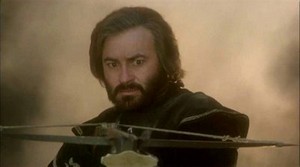 Erika brings her clueless pals along for the trip. By a coincidence of cosmic proportions, some comedy grave robbers also suddenly decide to dig up old Waldemar’s coffin and steal the silver cross that’s stuck in his heart. Cue resurrection. Cue terrorizing of villagers. Of course, the gals soon run into Waldemar, one of them naturally falling in love with him instantly. As suggested above, the rest of the movie pans out in a similar fashion to Werewolf Shadow, with those groovy mist-shrouded vampires and Waldemar doing their respective things until the inevitable climactic face-off. Perhaps I don’t sell it very well here, but if you’re a stranger to the series then this one is a great place to start and the most polished so far.
 Night was followed in 1983 by La bestia y la espada mágica(The Beast and the Magic Sword) – which has sadly managed to thus far elude your humble narrator. To get funding for this one, Naschy had to travel to Japan (where he also has a not inconsiderable cult following). If you can locate a copy for me, let me know! The idea of Daninsky vs. Samurai (oh yes, this happens) just sounds too good to be true. The same unfortunately applies to El aullido del Diablo (Howl of the Devil [1988]), which has Naschy in several roles including Daninsky, the Frankenstein Monster, Fu Manchu and Quasimodo. Not an Hombre-Lobo movie ‘proper’ as such, the Waldemar scenes are reportedly fantasies on the part of the main character, a failed actor.
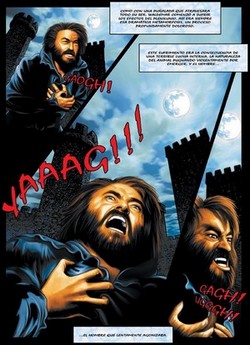
Maybe I’ll get to catch up with those movies sometime. Waldemar Daninsky still lives on – a comic book has been recently published by Fangoria Grafix chronicling new exploits and his films continue to be discovered by new generations of horror fans on DVD. Whilst there’s no danger of anyone ever comparing them with the work of Orson Welles or Stanley Kubrick, Naschy’s love of and tireless work in the genre can do nothing but win even the most hard-hearted genre fan’s undying affection and respect.
|
 robyn
robyn