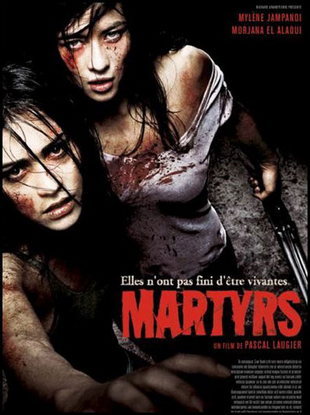
MARTYRS (2008)
Starring Morjana Alaoui & Mylène Jampanoï
Directed by Pascal Laugier
Written by Pascal Laugier
 I imagine many of us are familiar with the celebrated British film geek sitcom Spaced. And those of us that are may remember the episode in which Tim and Mike build their own heavily armed Robot Wars robot, on which they have inscribed the legend ‘TFU’ – which is revealed to stand for ‘The Fuckest Uppest.’
And oh, what a sought after title that has been in horror movies this past decade. I dare say that could be the epitaph for the 2000’s/Noughties/Zeroes or whatever the hell we’re going to end up referring to them as. ‘2000-2010: The Search for the Fuckest Uppest movie.’
 Call it ‘Gorno,’ call it ‘Torture Porn,’ call it ‘Absolutely Nothing That Hadn’t Been Done in the 70’s But With Better Make-up FX;’ dismiss it, embrace it or condemn it as you will, but there’s no denying that recent years have seen innumerable movies from all over the world striving to present pain, anguish and torment as harshly and in as much lingering detail as possible. Amongst others, the US gave us Eli Roth’s Hostel duo and Rob Zombie’s House of 1000 Corpses and The Devil’s Rejects; Australia gave us Greg McLean’s Wolf Creek and (albeit with US funding and facilities) James Wan’s Saw; Japan gave us Takashi Miike’s Audition and Ichi the Killer; us Brits have even had a go with the likes of Eden Lake and Mum & Dad. Oh, and let’s not forget that movie the erstwhile Mad Max made about Jesus.
Then there’s the French. Boy, they have not spared the horses of late, giving us a number of the most notable shockers of our time, in particular Alexandre Aja’s Haute Tension and Gaspar Noe’s Irreversible, and plenty more I’ve yet to see like Inside and Frontiers.
 And into this sprawling, bloody fray marches Pascal Laugier and his 2008 film Martyrs – and this already most divisive of subgenres finds itself even more divided: witness the 54% rating on Rotten-Tomatoes, a good indication of how much it splits audiences up the middle.
It’s not the easiest film to write about, as one can’t really convey a sense of just what it’s about without getting into spoilers. It’s not that Martyrs is a Shyamalan-esque twist movie, hinging on a single final revelation; rather, it’s a movie of two distinct halves, almost like two completely separate films soldered together. It seems specifically designed to mess with audience expectations, to bewilder, to infuriate. In this it is indubitably successful. Whether you’ll thank the movie for it is another matter entirely.
The next question, of course, is whether or not I should give a damn about spoiling the movie for the reader since I can’t honestly say I liked it that much anyway. Oh, the ethical struggles of an amateur internet hack. Oh what the hell, I’ll be reasonable and try to keep things as spoiler-light as I can...
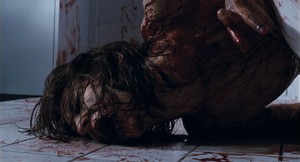
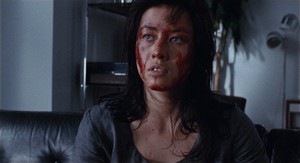
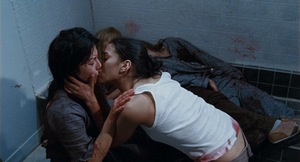
We don’t know the ins and outs of what has happened to young girl Lucie, but we know it was twisted and brutal. We know she was held captive, tortured, and naturally left a quivering wreck by it all. And we know that, at the orphanage that takes her in after she somehow escapes her captors, she’s befriended by another girl of her age, Anna; a kinship which quickly becomes devotion, though perhaps not in a wholly mutual sense. But Lucie hasn’t just been left traumatised by her experience; she’s left haunted, in a literal sense. Something not quite of this world is plaguing her, tormenting her, unseen by anyone else.
Cut to fifteen years later: Lucie (now played by Mylene Jampanoi) believes she has found those who held her prisoner, and with the assistance of the ever-faithful Anna (Morjana Alaoui) sets about taking her revenge. But Martyrs is not quite your ho-hum, run of the mill revenge story. There’s still the matter of the thing that’s haunting Lucie. And there’s still the matter of just what was being done to her in the first place, and why.
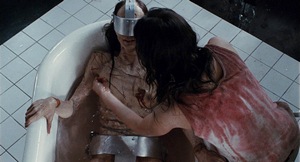 Aye, there’s the rub. For it’s in taking us into the latter question, and turning into near-enough a whole different movie once the initial narrative has largely run its course, that Martyrs really steps into the let’s-fuck-with-the-audience zone. We’ve all heard what they say about the line between genius and insanity, and I think it’s safe to say that one’s a damn sight easier to achieve than the other; after all, just because you have an idea that’s insane, that doesn’t necessarily make it genius. But I get the distinct impression that’s what Laugier was after.
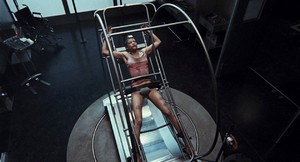
Still, while it may wind up being a film that’s easy to dislike, Martyrs is also a film that it’s difficult not to feel some admiration for. It’s undeniably a well made, well designed film, beautifully photographed and powerfully performed. And, considering how often we horror fans decry Hollywood’s inventiveness deficit, you kind of have to respect any film or filmmaker making a conscious effort to subvert convention. There have been plenty of horror movies in recent years that have taken a similar approach, taking what initially appears a fairly standard horror down an abstract road, and it has paid off: take Neil Marshall’s masterpiece The Descent, and Aja’s Haute Tension. Having said that, some of the conventions of storytelling persist for good reason; i.e. they actually work. As I’ve already intimated, unusual doesn’t automatically equal good. Martyrs is indeed a challenging film in its unapologetic displays of torture, and its refusal to provide easy answers, and there’s a lot to be said for forcing the viewer to do a bit of work and come to their own conclusions. However, sometimes the conclusion reached may well be, “that’s a load of bollocks.” (See also All the Boys Love Mandy Lane.)
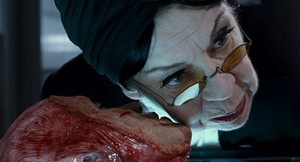 I’d be lying if I said I had completely made my mind up about Martyrs; since watching it I’ve been continually running over it in my head, replaying everything, rethinking everything, which I have no doubt is precisely what Laugier wants. Maybe when (if) I watch it again, I’ll see it all in a whole new light, but right now I’m struggling to see it as anything more than pretentious, smug, self-aggrandising nonsense. Or as the French might put it, c’est la merde.
Nevertheless, it’s still fair to say it scores pretty high on the fuckest-uppest scale.
|
 ben
ben