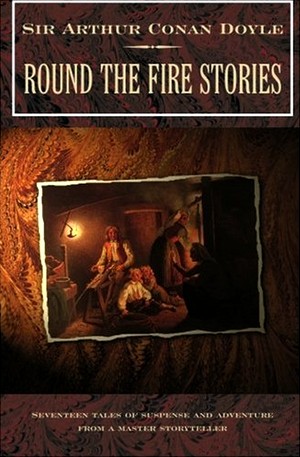
 Round the Fire Stories (1908)
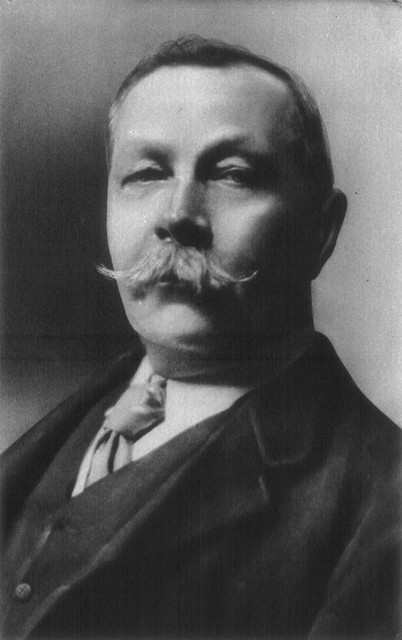
Sir Arthur Conan Doyle
STEEL TRUE
BLADE STRAIGHT
ARTHUR CONAN DOYLE
KNIGHT
PATRIOT, PHYSICIAN & MAN OF LETTERS
-Epitaph on Sir Arthur Conan Doyles headstone.
In horror stories, as in life, it is not the known but rather the unknown that often possesses the greatest ability to frighten us. The human ability to grasp for the dark and often sinister explanation is as common as it is primal.
This, explored to an intricate and artful degree by a true master storyteller, is at the crux of Round the Fire Stories. Originally published in 1908 and out of print for more than half a century, this book is one worth tracking down. It contains seventeen stories that were meant to be "read round the fire" on a cold winters night. Murder, insanity, ghosts, unsolved disappearances and treacherous crimes make up this collection.
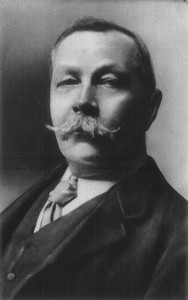
The author is someone who might not previously be associated with the topic of horror. He did however, for much of his life, possess an intense fascination with the paranormal that was the basis for and eventually the ruin of his friendship with a legendary escape artist, Houdini.
"Such was the position of affairs when, upon the evening of Monday, June 21st, there came a fresh development which changed what had been a mere village scandal into a tragedy which arrested the attention of the whole nation. Some detail is necessary to cause the facts of that evening to present their full significance."
- The Black Doctor
Sir Arthur Conan Doyle is synomous with one of the most famous and well loved detectives of all time. His logic loving and intensely complex creation, Sherlock Holmes has been a favorite of mystery fans for decades. The detective in the deerstalker was not, however, the way in which Doyle wanted to be remembered for. He felt that his best work lay no with the fiercely intelligent and at times pompous investigator but rather in a work such as this where he was free to explore mysteries of a more complex and at times supernatural level.
Born in Scotland, Sir Arthur Conan Doyle was a practicing doctor when he began to write tales of mystery and adventure. In addition to the Sherlock Holmes stories, Conan Doyle also wrote the Professor Challenger adventures, and his classic, The Lost World, is one of the original fantasy novels. Arthur Conan Doyle (1859-1930) was born in Edinburgh and studied medicine at the University of Edinburgh's Medical School. Graduating in 1881, he set up practice as an occultist, but as patients proved elusive he turned to writing. An important influence upon his literary career was his professor, Dr. Joseph Bell, who could observe the minutest detail regarding a patient's condition. This master of deduction became the model for Conan Doyle's legendary literary creation, the detective Sherlock Holmes, introduced in A Study in Scarlet in 1887. Conan Doyle also promoted spiritualism and devoted extensive time and effort to a campaign of support for this cause. His non-fiction includes military writing on the Boer War and pamphlets on spiritualism. Sherlock Holmes was the first detective to solve cases by deduction rather than due to an error by the criminal, Conan Doyle therefore can be credited with creating the modern detective novel. He was knighted in 1902 for his support of the British cause in the Boer Wars. After the death of his son in the First World War, he devoted the rest of his life to spiritualism on which he wrote and lectured.
"Mr. Stanniford," said he, in a cracking voice, "I hope you will prepare yourself in case any shock should be awaiting you when that seal is removed and the door is opened."
- The Sealed Room
Doyle is able to expertly whet your appetite from the first paragraph to wondering what lies at the base of the mystery. Techniques that have passed into appear clichéd appear here in their original incarnation. "If I had but know what lay behind the locked door I might not have longed to know its secrets."
 Some of these offerings are simple locked door mysteries, classic whodunits and howdunnits but others are more complex such as one involving a sealed room that should never be opened, or a séance that produces a mystical but terrifying result. There are villains that charm even as they conspire to hideously murder, exploration of strange and horrific torture practices of ages past that have left their bloody imprint on modern consciousness, and beasts of the exotic locale that are fiercer than any human predator.
Seamlessly woven into the layers of each tale are the threads of human behavior that are in fact, more to blame for our fears than any ghost or demon. Humans bring our own special misery and terror to life and this, Doyle asserts in his inimitable way, is the essence of horror. He doesn't preach or ramble but rather lets the actions of his characters speak for the horror that may or may not exist within humanity. Take for example the villain all too eager to let his prize puma devour a man alive simply to inherit a fortune. When many books or movies would have you be fearful of a killer who slays with little care for rationale or reason, Doyle instead firmly reminds us that it those who act with clever culpability and cruel intent that are the monsters of the world.
"My word!" said he, "what a night!"
It was, indeed. The wind was howling and screaming round the house, and the latticed windows rattled and shook as if they were coming in. The glow of the yellow lamps and the flavor of our cigars seemed the brighter and more fragrant for the contrast.
- The Brazilian Cat
To read Doyle is to savor the lush, while at times somewhat antiquated, language of his text. These are not words to be gulped down like fast food but rather to be carefully and richly savored. Doyle adroitly leads the reader through his tales with clever plot twists that captivate even as they mystify. These offerings are about the exceptional art of telling the story itself and there is a sheer and unadulterated pleasure in reading them. Right from the first sentence that sets the pace and mood, the reader maintains a creeping dread at what may lay ahead in the conclusion of the tale.
|
 karyne